
Family Feeding — Letting Go of the “Perfect Meal” - Part 1
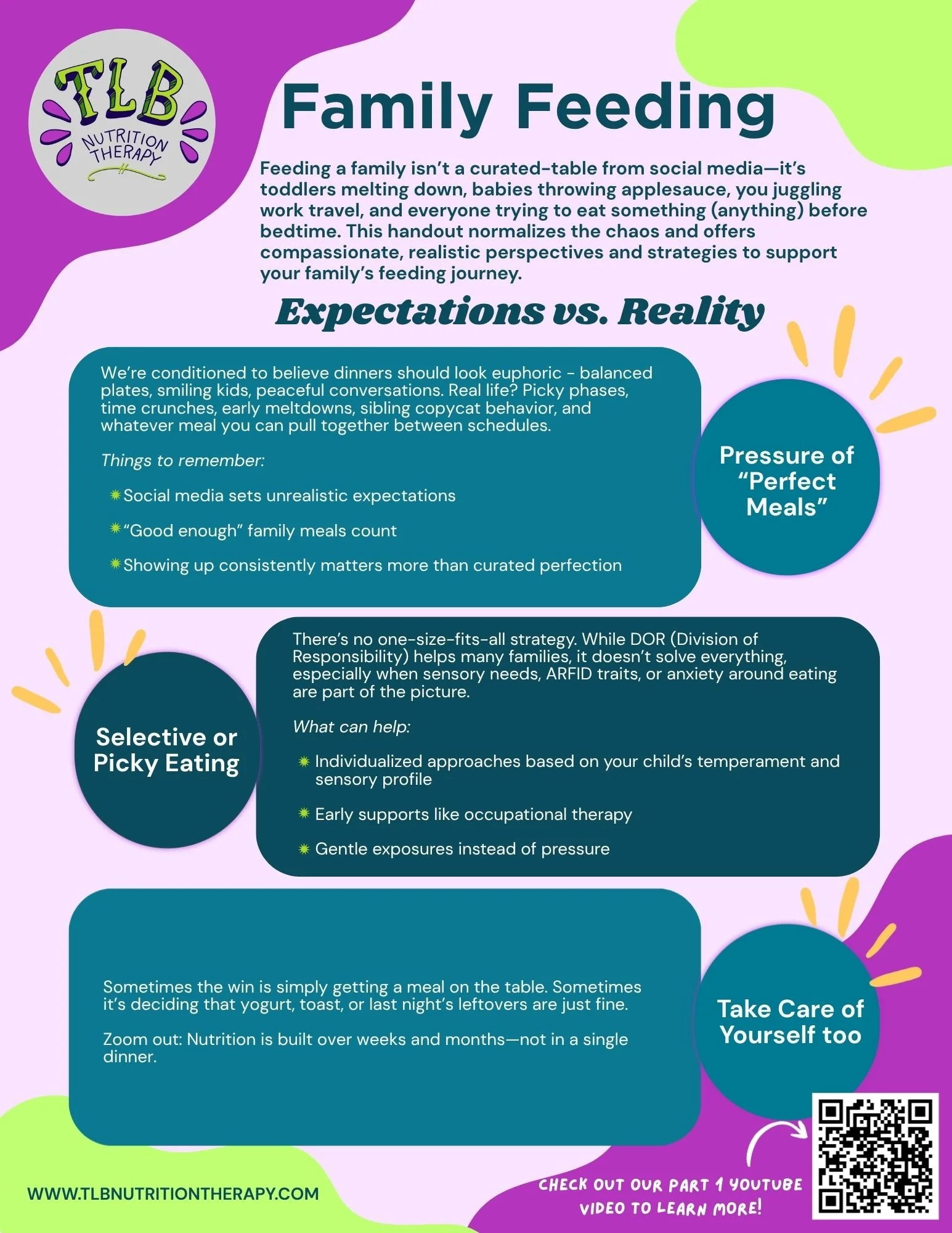
Click the image above for the PDF to download
Family meals rarely look like the version we see online. Sometimes dinner is balanced plates and everyone sitting happily at the table. Other nights, it's a toddler melting down, a baby throwing food, competing schedules, and whatever you can get on the table before bedtime.
At TLB Nutrition Therapy, we believe “good enough” meals count. Nutrition is built over days, weeks, and months—not determined by one dinner. Consistently feeding your family matters far more than creating a perfectly balanced or picture-worthy meal every night.
Selective eating can make family meals even more complicated. While approaches like the Division of Responsibility can be helpful for some families, they aren't one-size-fits-all—particularly when sensory differences, anxiety, or ARFID traits are involved. Individualized strategies, occupational therapy when appropriate, familiar foods, and gentle exposures without pressure may be more supportive.
And parents matter in this equation, too. Feeding a family takes physical, emotional, mental, and logistical energy. Sometimes yogurt and toast are dinner. Sometimes you serve the same five meals on repeat. Sometimes protecting your own capacity is the best thing you can do for your family.
The goal isn't a perfect family meal. It's creating a feeding environment that supports connection, flexibility, nourishment, and your family's actual needs.
Family Feeding — Expectations vs. Reality
Family dinner doesn't always look like the picture-perfect meals we see on social media—and that's okay. In this episode of Snack Chats, Tina and Tabitha get candid about the reality of feeding a family while juggling toddlers, babies, selective eating, sensory needs, work, travel, budgets, schedules, and plain old exhaustion.
This is Part 1 of our Family Feeding series, focusing on letting go of unrealistic expectations and approaching family meals with more flexibility and compassion.
In this episode, you'll learn:
Why social media can create unrealistic expectations around family meals
Why "good enough" meals absolutely count
How selective and picky eating can affect the entire family
When the Division of Responsibility (DOR) may be helpful—and when a more individualized approach may be needed
How sensory needs, anxiety, and possible ARFID can influence eating
Why gentle exposures may be more supportive than pressure
How sibling dynamics can influence food preferences and behaviors
Why repeating the same meals isn't necessarily a problem
How decision fatigue and burnout affect family feeding
Why parents need compassion and support, too
How to zoom out and look at nutrition over time instead of judging a single meal
Tina and Tabitha emphasize that successful family feeding doesn't mean everyone eats the same perfectly balanced dinner every night. Sometimes success means getting something on the table. Sometimes it means offering a familiar food. And sometimes it means lowering the bar because everyone—including the parent—is exhausted.
Download our free handout: Family Feeding. Part 1 of this resource explores expectations versus reality, the pressure of "perfect meals," selective and picky eating, individualized feeding approaches, and why taking care of yourself matters, too. Part 2 goes further with strategies for redefining success at the table, creating a lower-pressure eating environment, building flexible meals, including safe or familiar foods, and leaning on your community for support.
Stay tuned for Part 2, where we'll talk about practical ways to reduce decision fatigue, simplify family meals, and protect your mental bandwidth while feeding your family.
Disclaimer:
The information shared in this episode is intended for educational purposes only and is not a substitute for individualized nutrition counseling, medical advice, occupational therapy, feeding therapy, or mental health treatment. Every child and family has different needs, and individualized support may be helpful when feeding challenges are affecting nutrition, growth, family functioning, or quality of life.