Understanding Physical Hunger and Logical Hunger
Click the image above for the PDF to download
“Eat when you’re hungry and stop when you’re full” sounds simple—but for many people, hunger doesn’t work that way.
Hunger cues can be influenced by stress, illness, medications, neurodivergence, inconsistent eating patterns, eating disorder recovery, and many other factors. Sometimes your body gives you clear physical signals that it needs food. Other times, those signals may be subtle, delayed, or completely absent. That doesn’t mean your body doesn’t still need nourishment.
At TLB Nutrition Therapy, we talk about both physical hunger and logical hunger. Physical hunger can show up in many ways, including stomach growling, difficulty concentrating, low energy, headaches, irritability, or simply thinking more about food. Logical hunger uses outside information—such as how long it has been since you last ate—to recognize when your body needs nourishment even if you aren't physically feeling hungry.
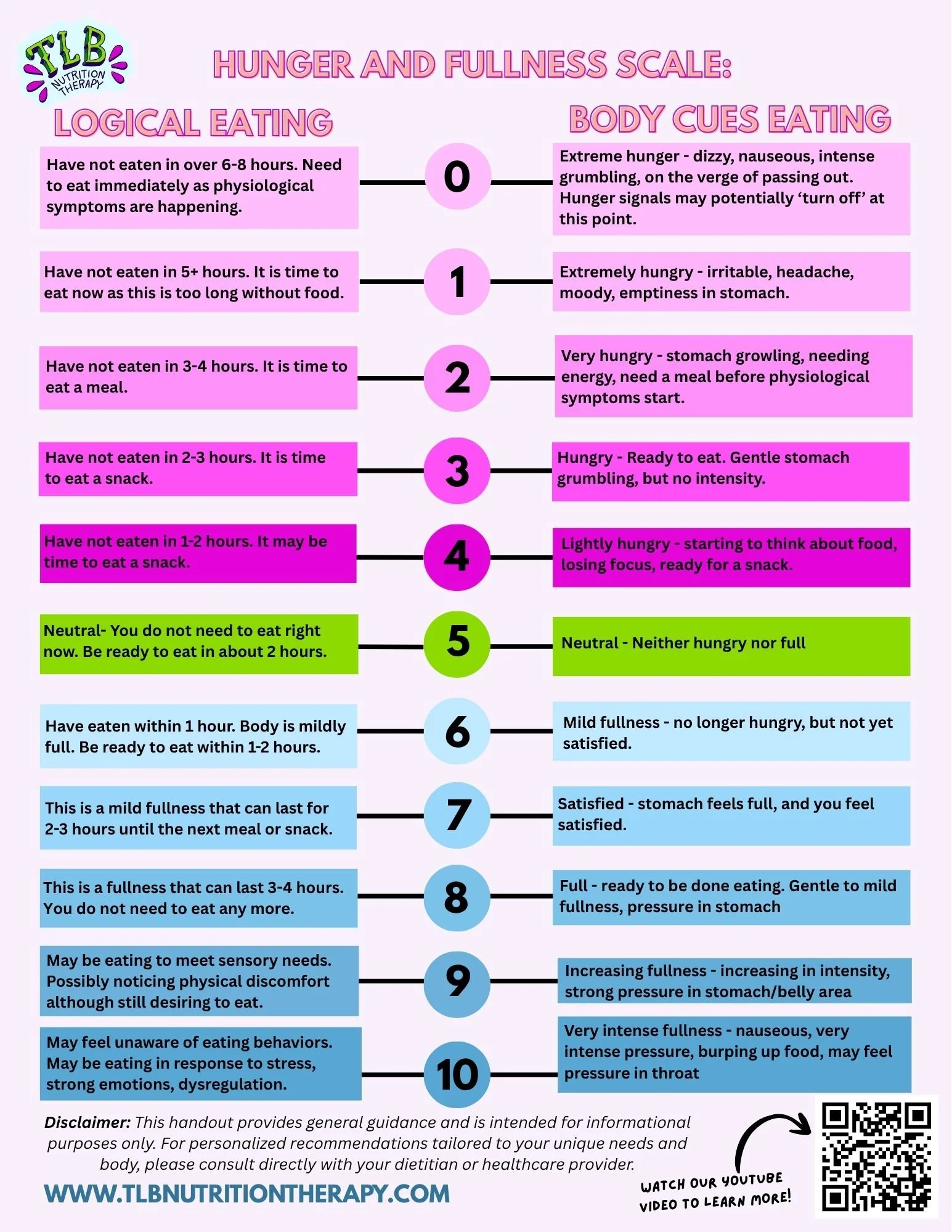
Our Hunger and Fullness Scale places these concepts side-by-side. For example, the handout shows that someone may logically recognize that it is time for a meal after three to four hours even if their body isn't providing strong hunger cues. It also explores the spectrum from extreme hunger through neutrality and into different levels of fullness.
Learning to nourish yourself isn't about perfectly following hunger and fullness cues. Sometimes listening to your body means recognizing its signals, and sometimes it means using structure, knowledge, and compassion to give your body what it needs even when those signals aren't available.
Physical Hunger vs. Logical Hunger
Hunger isn't always as simple as "eat when you're hungry." In this episode of Snack Chats, TLB Team Lead Dietitians Ana and Marcie explore the difference between physical hunger and logical hunger and why both can play an important role in building a consistent and compassionate relationship with food.
Whether you're navigating eating disorder recovery, neurodivergence, appetite changes, medications, stress, or simply trying to better understand your body's cues, this conversation offers a more flexible way to think about hunger and nourishment.
In this episode, you'll learn:
What physical hunger is and how it can show up in the body
Why hunger isn't limited to a growling stomach
How stress, illness, medications, neurodivergence, and inconsistent eating can affect hunger cues
What logical hunger is and why it can be helpful
How mechanical or functional eating can support consistent nourishment
Why regular meals and snacks can help rebuild trust with your body
How restriction and inconsistent eating can affect hunger and fullness cues
Practical tools like alarms, reminders, safe food lists, and meal support
Why curiosity and flexibility are more helpful than rigid rules
Ana and Marcie emphasize that body attunement isn't about perfectly responding to every internal cue. Sometimes your body clearly tells you it's hungry, and sometimes you may need to use logic, structure, or outside support to meet your needs. Both are valid ways of caring for your body.
Download our free handout: Hunger and Fullness Scale. This visual tool compares Logical Eating with Body Cues Eating across a 0–10 scale, helping you explore both physical sensations and practical timing cues. It can be used as a flexible resource for recognizing hunger, fullness, satisfaction, and when your body may need nourishment even without strong physical hunger signals.
Disclaimer:
The information shared in this episode is intended for educational purposes only and is not a substitute for individualized nutrition counseling, medical advice, or mental health treatment. Hunger and fullness experiences are highly individual, and we encourage you to work with a registered dietitian or healthcare provider for support tailored to your unique needs.